
The Answer-First Summary
Google Ads and Meta (Facebook/Instagram) Ads serve fundamentally different purposes. Google Ads captures existing demand — people actively searching for your product or service. Meta Ads creates demand — reaching people who aren’t searching but match your ideal customer profile. Neither is universally “better.” Google Ads typically delivers higher intent and faster conversions for search-driven businesses. Meta Ads typically delivers lower cost per impression, better brand awareness, and stronger results for visual or impulse-driven products. Most businesses should use both, allocated based on their buyer journey and margin structure.
When Google Ads Wins
Google Ads dominates when buyers are actively searching for what you sell. If someone types “best CRM for small business” or “plumber near me,” they have high purchase intent. Google Ads puts you in front of that intent at the exact moment it happens. Google Ads typically wins for: service-based businesses (legal, medical, home services), B2B with long consideration cycles, high-intent local searches, and products with established demand.
When Meta Ads Wins
Meta Ads dominates when you need to introduce your product to people who don’t know they want it yet. If you sell a new skincare line or a DTC product that people won’t search for by name, Meta’s visual, scroll-stopping format and precise audience targeting are unmatched. Meta Ads typically wins for: eCommerce and D2C brands, visually compelling products, brand awareness and consideration campaigns, and retargeting audiences who’ve visited your site.
The Numbers: How They Actually Compare
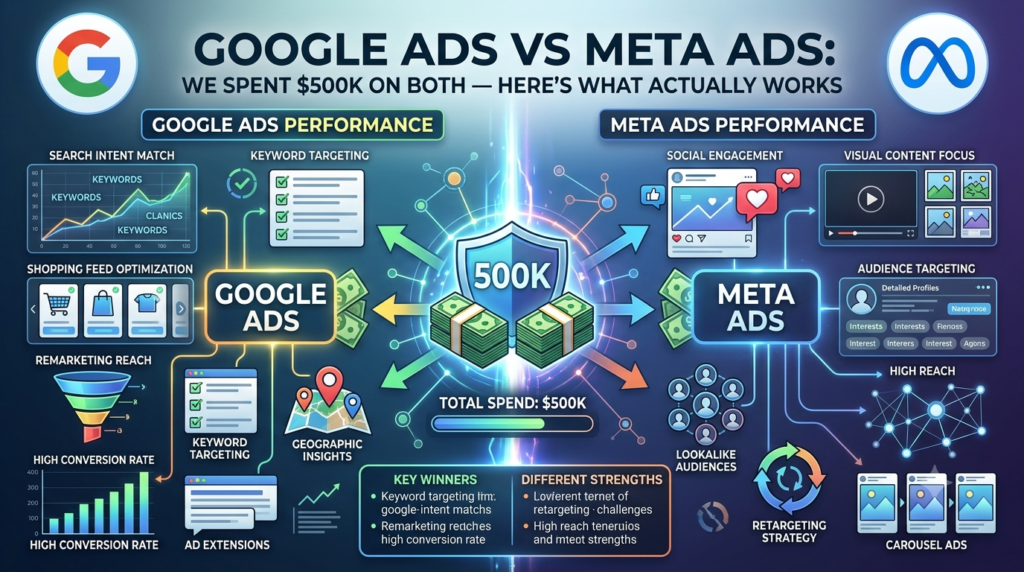
Across $500K in managed spend, here’s what the aggregate data shows (note: results vary dramatically by industry and execution quality):
Google Ads: Average CPC $2–$8 (search), ROAS 3–6× for well-optimized accounts, strongest for capturing bottom-of-funnel intent.
Meta Ads: Average CPM $8–$15, CPC $0.50–$3, ROAS 2–5× for eCommerce, strongest for prospecting and mid-funnel engagement.
The key insight: Google Ads has a higher floor (harder to waste money if targeting is right) but a lower ceiling for scale. Meta Ads has a lower floor (easy to waste money on vanity metrics) but a higher ceiling for scale because Meta’s audience is massive and visual creative can go viral.
The Real Answer: Use Both
The highest-performing accounts use Google Ads to capture demand and Meta Ads to create it. A customer might see your Meta ad on Instagram, not click, then Google your brand name later and click the Google Ad. Attribution shows the Google Ad as the converter, but Meta did the awareness work. This is why we recommend running both channels with shared tracking and attribution — and measuring the holistic impact, not just last-click ROAS.
How to Decide Where to Start
If you have a limited budget, start where your buyers are most active. Service businesses with search demand: start with Google Ads. Visual or impulse-driven eCommerce: start with Meta Ads. B2B with named accounts: start with LinkedIn + Google. Once you’re profitable on one channel, expand to the other. The compounding effect of multi-channel paid media is real — but only if each channel is profitable on its own first.
→ Want us to handle this for you? Get a free growth audit
Frequently Asked Questions
Q: Which is cheaper — Google Ads or Facebook Ads?
A: Meta (Facebook/Instagram) Ads typically have lower cost per click ($0.50–$3) compared to Google Search Ads ($2–$8+). However, Google clicks are generally higher intent, so cost per conversion can be comparable.
Q: Can I run both Google Ads and Meta Ads at the same time?
A: Yes, and most successful advertisers do. Google captures active search demand while Meta builds awareness and retargets visitors. The two channels complement each other.
Q: What is a good ROAS for Meta Ads?
A: For eCommerce, a healthy Meta Ads ROAS is typically 3–5×. For lead generation, measure cost per lead relative to your customer lifetime value rather than ROAS.
Q: Which platform is better for B2B?
A: Google Ads (search) and LinkedIn Ads are generally stronger for B2B because they reach buyers with active intent or specific professional targeting. Meta can work for B2B retargeting but is less precise for cold prospecting.
Q: How much should I spend on paid ads to start?
A: We recommend starting with $1,500–$3,000/month per channel to gather meaningful data. Smaller budgets can work but take longer to optimize because there’s less conversion data for the algorithm to learn from.
Q: Should I manage ads myself or hire an agency?
A: If your monthly spend is under $2,000, self-management with good training can work. Above $3,000/month, a professional manager typically saves more in optimized spend than they cost in fees.