
The Answer-First Summary
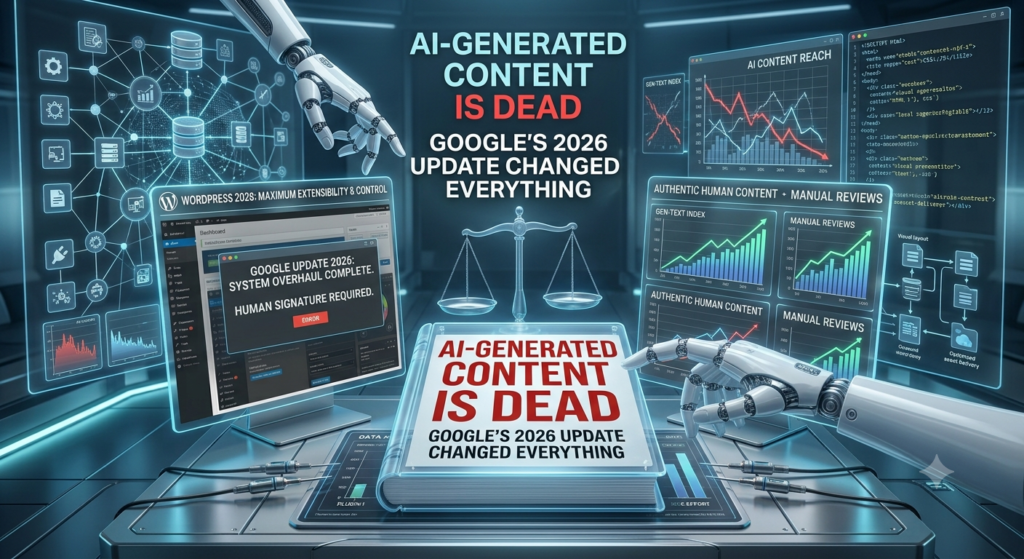
Google’s 2026 Helpful Content classifiers can now detect and deprioritize AI-generated content that lacks original insight, personal experience, or genuine expertise. Mass-produced AI content — the kind generated by hitting “publish” on ChatGPT outputs without editing — is being systematically filtered from search results. What still works: AI as a drafting tool combined with human expertise, original research, first-party data, genuine opinion, and experience-based insight. The winning formula is AI-assisted, human-authored content that demonstrates real E-E-A-T (Experience, Expertise, Authoritativeness, Trustworthiness).
What Google’s Update Actually Changed
Google didn’t ban AI content. It penalized content that adds no value beyond what AI can generate on its own. The classifier looks for signals of genuine human contribution: original analysis, personal experience, unique data, expert opinion, and depth that goes beyond surface-level information. If your content reads like every other AI-generated article on the topic, it gets filtered. If it reads like an expert used AI to organize their thinking but added genuine insight, it ranks.
Why “Just Use AI” Stopped Working
In 2024–2025, many businesses adopted a strategy of mass-producing AI content. Publish 50 blog posts a month, cover every keyword, scale to hundreds of pages. It worked briefly — then Google caught up. The Helpful Content classifier now identifies patterns common in AI-only content: predictable paragraph structure, lack of specific examples, absence of cited sources, generic conclusions, and no author expertise signals. Sites that scaled with pure AI content saw 40–90% traffic drops.
The Content That Ranks Now
AI-assisted, human-authored content. Here’s what that looks like in practice:
Use AI for: research, outlining, first drafts, data organization, formatting, and idea generation.
Humans must add: original insights from experience, specific examples and case studies, first-party data and statistics, genuine expert opinions, a unique perspective or framework, proper citations and sources, and editorial judgment about what matters and what doesn’t.
The test: if you removed your name from the content, could anyone have written it? If yes, it’s not differentiated enough. Add your experience, your data, your perspective.
How to Future-Proof Your Content Strategy
Build content around expertise you actually have. Interview subject matter experts for every piece. Include original data, screenshots, or case studies. Publish with named authors who have verifiable credentials. Create content formats AI can’t replicate: original research reports, proprietary frameworks, first-party survey results, and experience-based guides. And use AI as your writing assistant, not your replacement.
→ Want us to handle this for you? Get a free growth audit
Frequently Asked Questions
Q: Did Google ban AI-generated content?
A: No. Google’s guidelines state they reward helpful content regardless of how it’s produced. However, Google’s classifiers can detect and deprioritize content that adds no value beyond what AI alone can generate — regardless of whether AI was used.
Q: Can I still use AI tools for content creation?
A: Yes. AI is an excellent drafting, outlining, and research tool. The key is adding genuine human expertise, original insight, and editorial judgment to every piece before publishing.
Q: What is E-E-A-T and why does it matter?
A: E-E-A-T stands for Experience, Expertise, Authoritativeness, and Trustworthiness. Google uses these signals to evaluate content quality. Content from identifiable experts with real experience ranks better.
Q: How can I tell if my content will be penalized?
A: Ask: does this content add something an AI couldn’t produce on its own? Does it include original examples, personal experience, or unique data? If not, it’s at risk.
Q: How much AI content is too much?
A: There’s no percentage threshold. The issue isn’t how much AI was used in production, but whether the final content demonstrates genuine expertise and unique value.
Q: What should I do if my traffic dropped after the update?
A: Audit your content for thin, AI-only pages. Update or consolidate pages that lack original insight. Add author bios, citations, and first-party examples. Focus on depth and expertise over volume.
Q: Is AI content good for SEO?
A: AI-assisted content with human expertise, original insights, and proper E-E-A-T signals performs well. AI-only content without human value-add is being filtered by Google.