The Answer-First Summary
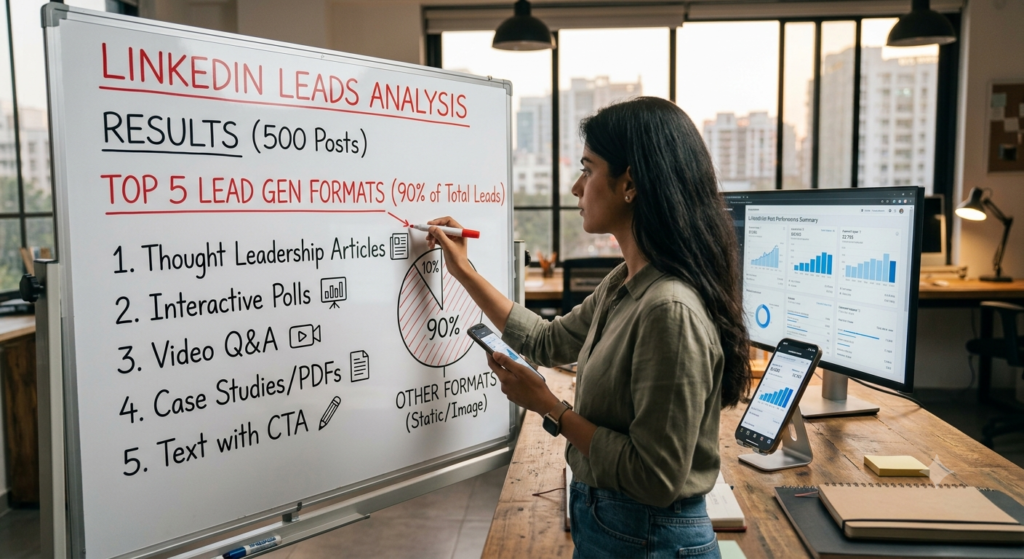
After analyzing 500 LinkedIn posts across B2B accounts, the 5 formats that generated 90% of all inbound leads were: personal story posts with a business lesson (highest engagement), contrarian hot takes that challenge industry assumptions (highest share rate), step-by-step how-to breakdowns with actionable frameworks (highest save rate), before-and-after case study snapshots with specific numbers (highest conversion rate), and carousel documents that teach a framework visually (highest reach). Text-only promotional posts, company announcements, and generic motivational quotes generated almost zero leads.
Format 1: Personal Story + Business Lesson
LinkedIn’s algorithm in 2026 heavily rewards posts that keep people reading. Nothing keeps people reading like a compelling personal story. The formula: open with a surprising or relatable personal moment, connect it to a business insight, and end with a takeaway the reader can apply. These posts consistently get 3–5× the engagement of company-style content because they feel human, not corporate.
Format 2: Contrarian Hot Takes
Posts that open with “Unpopular opinion:” or directly challenge a widely-held belief generate the most comments and shares. Why: people either strongly agree (and share) or strongly disagree (and comment). Both signals tell LinkedIn to distribute the post further. The key is being genuinely contrarian, not fake-controversial. Take a real stance, back it with your experience, and invite discussion.
Format 3: Step-by-Step How-To Frameworks
Posts that teach something actionable in a numbered, step-by-step format get saved and bookmarked at the highest rate. These position you as a practitioner, not just a commentator. The best-performing format: a numbered list of 5–7 steps, each with a one-sentence explanation. Short enough to read quickly, detailed enough to be useful.
Format 4: Before-and-After Case Snapshots
A short post showing: “Here’s where Client X was → Here’s what we did → Here’s the result (with specific numbers)” converts readers into leads at the highest rate. Why: it’s proof, not promise. People can see themselves in the “before” and want to get to the “after.” Keep it under 200 words and end with a soft CTA like “DM me if this sounds like your situation.”
Format 5: Carousel Documents
PDF carousels (uploaded as documents) get the highest reach on LinkedIn because they’re swipeable and keep users engaged longer. Design a 6–10 slide carousel that teaches a framework, shows a process, or breaks down a comparison. Each slide should have one clear point with large, readable text. End the last slide with a CTA.
What Doesn’t Work on LinkedIn in 2026
Company page posts with corporate announcements (low reach), generic motivational quotes (no engagement), links in the post body (LinkedIn deprioritizes external links), long text blocks with no formatting (people scroll past), and AI-generated posts without human voice or personal perspective (LinkedIn’s algorithm actively deprioritizes generic AI content).
→ Want us to handle this for you? Get a free growth audit
Frequently Asked Questions
Q: How often should I post on LinkedIn for lead generation?
A: 3–5 times per week from your personal profile is the sweet spot. Consistency matters more than volume. Posting daily can work but only if quality stays high.
Q: Do LinkedIn company pages or personal profiles perform better?
A: Personal profiles consistently outperform company pages by 5–10× in reach and engagement. Use your personal profile for content and your company page for brand credibility.
Q: Should I include links in my LinkedIn posts?
A: Avoid links in the post body — LinkedIn reduces reach for posts with external links. Instead, put the link in the first comment and say “link in comments.”
Q: What time should I post on LinkedIn?
A: Tuesday through Thursday, 8–10am in your target audience’s timezone, consistently performs best. But consistency matters more than perfect timing.
Q: How do I generate leads from LinkedIn without being salesy?
A: Share valuable content that demonstrates expertise, use soft CTAs like “DM me if this resonates,” and engage in comments on other people’s posts. Build trust through content, not cold pitches.
Q: Does LinkedIn engagement actually lead to sales?
A: Yes, but the sales cycle is longer. LinkedIn builds trust and awareness that converts into inbound leads over weeks and months, not immediate transactions.